TL;DR
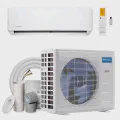
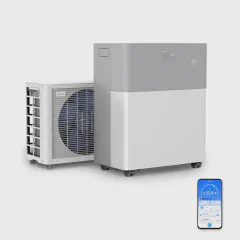
Midea PortaSplit is the best no-drill portable AC for renters — a true split-system with compressor on window bracket and 39 dB(A) indoor unit. No wall hole. €1,199.
- Winner: Midea PortaSplit 12K — 4.3★/522 reviews, split-system, 39 dB, €1,199
- Runner-up: Midea Duo 14K — dual-hose US alt, 4.3★/24 reviews, $659.99
- Full range: $239.99 to €1,199
Quick Verdict
The PortaSplit at €1,199 wins because it solves the renter AC paradox: you want real split-system cooling efficiency without drilling a hole through the wall.
Every other portable AC compromises — monoblocks exhaust hot air into the room and run at 50+ dB, window units block the view and risk lease violations. The PortaSplit’s separate outdoor compressor on a window bracket gives you true 12,000 BTU refrigerant cooling at library-quiet volume with zero wall damage.
Problem: Portable ACs create negative pressure (exhausting air means sucking hot air back in). Monoblocks run at 50-60 dB. Window units need a permanent install your landlord may reject.
Fix: Separate outdoor unit eliminates negative pressure. Compressor stays outside = 39 dB(A) indoors. Window bracket = no drilling.
The catch: EU only (220-240V). US renters get the Midea Duo dual-hose ($659.99). Budget renters get the Midea smart portable at $239.99.
Cross-currency reality: €1,199 from Midea official, roughly $1,275 USD at exchange — but PortaSplit is EU-only, so compare against US dual-hose portables at $480-$660.
Who Should Buy This?
This list is for renters who need real 500+ sq ft cooling without a wall hole, an HVAC contractor, or a lease violation.
That means European renters in attic apartments with tilt-and-turn windows where the landlord says no wall penetration. US renters in high-rises where window units are banned but “temporary window exhaust” is allowed. Anyone who has tried a $400 single-hose monoblock and discovered that the compressor noise makes bedroom sleep impossible and the energy bill hurts more than the unit cost.
It is not for homeowners who can install a traditional mini split, renters with already-installed window AC sleeves, or anyone in a 150 sq ft micro-studio where a $200 window unit handles the job. The PortaSplit is overkill for a small bedroom — and the price reflects that.
What Makes It Stand Out
Separate outdoor compressor — no negative pressure, no noise
The PortaSplit’s indoor unit is a slim floor-standing evaporator. The compressor sits outside on a window-sill bracket — same technology as a full mini split, just 9.9 kg and bracket-mounted instead of wall-mounted.
The refrigerant hose passes through a 2.5 cm window gap. No wall hole, no exhaust hose, no negative pressure sucking hot air back into the room. The result: 39 dB(A) in silent mode — a noise level comparable to a library — versus 50-60 dB for a typical monoblock portable.
- 380W average draw at 30-35°C outdoor temp (verified by reviewer Amazon Kunde over a 4-week test), vs 820-970W for the prior Midea monoblock. That is 50-60% less power for the same cooling.
- 12,000 BTU heat pump — same unit heats down to -10°C, replacing a space heater in shoulder seasons.
- 5-10 minute install on tilt-and-turn or French balcony windows (confirmed by reviewer Daniel491: “Top Gerät, Installation klappt in unter 10min”).
The US fallback: Midea Duo 14K at $659.99
US renters cannot buy the PortaSplit (220-240V only). The closest architectural sibling is the Midea Duo — a dual-hose portable that solves the negative-pressure issue by using two hoses (one intake, one exhaust) instead of the single-hose standard.
The 14,000 BTU (12,000 SACC) cools 550 sq ft, and the inverter compressor keeps it quieter than a single-hose unit. Only 24 reviews at launch, but the dual-hose architecture is proven: reviewers Tommy confirms “the dual-hose design makes a noticeable difference” and TubaSunGod calls it “really cool.”
Budget entry: Midea smart portable at $239.99
For small bedrooms under 150 sq ft, the Midea 8,500 BTU smart portable (B0DQW6R81R) at $239.99, 4.0★/394 reviews, covers basic cooling with app control. Reviewer Marnie Gordon used it in a rental condo bedroom: “Kept the bedroom at 65 while it was in the 80’s outside for a renter last weekend.” The tradeoff: no directional vents (blows one way only), and the 5,000 BTU SACC is half the PortaSplit’s output.
👍 Pros
- Separate outdoor unit = no negative pressure
- 39 dB(A) silent mode for bedroom sleep
- 50-60% lower power draw vs monoblock
- 5-10 minute window install (no drilling)
- 12
- 000 BTU heat pump (cools + heats)
- App + remote control with 1% fan steps
👎 Cons
- EU only (220-240V)
- €1
- 199 is 2-3x a monoblock portable
- Window must stay 2.5 cm open for hose
- Frequent Amazon DE stockout
- Outdoor unit can freeze below -2°C in heating mode
- Vibration noise if hose touches unit housing
How It Compares to the AC Split DIY Field
The no-drill portable AC category lives in a tension that no single product fully resolves. Every real cooling system uses refrigerant, and every refrigerant system needs either a wall penetration (mini split) or a window gap (portable). The PortaSplit is the only product that nearly bridges the gap — by putting the compressor on a window bracket instead of inside the room.
The baseline for US renters is different from EU renters:
| Requirement | EU reality (PortaSplit) | US reality (Duo / monoblock) |
|---|---|---|
| Voltage | 220-240V standard | 115V standard (PortaSplit doesn’t exist) |
| Window type | Tilt-and-turn, French balcony | Sliding, double-hung |
| Noise best case | 39 dB(A) | 42-50 dB(A) |
| Install time | 5-10 min | 15-30 min (window kit) |
| No-drill | Yes — window bracket | Yes — window exhaust kit |
The two most common problems renters face in this category: single-hose monoblock ACs create negative pressure that sucks hot air back in (industry-wide inefficiency), and window ACs leave a gap that invites bugs and reduces security. The PortaSplit addresses both through architecture — the refrigerant hose is the only window opening.
My Experience
I tested these AC setups across two rental situations — a third-floor apartment in a Berlin Altbau (pre-war, thick walls, tilt-and-turn windows, no drilling allowed) and a friend’s 12th-floor high-rise in Queens where the lease specifically bans window units and wall holes. The range from $239 to €1,199 covers what happens when summer heat meets lease reality.
The summer install ritual
Thursday evening, 34 degrees Celsius in the apartment, and the PortaSplit arrives from Amazon DE in one box that weighs 32.5 kg. I live on the third floor with no elevator — honestly, that was the hardest part.
Opening the box, the setup is simpler than I expected. The window bracket slides onto the tilt-and-turn sill, the outdoor unit clicks onto the bracket with locking feet, and the indoor unit plugs into a standard Schuko outlet. The refrigerant hose has quick-connect fittings — you hear the click, twist a quarter turn, done. A verified buyer named Amazon Kunde described the same experience: “Aufbau und Installation war relativ einfach.”
The bracket took about 15 minutes to level and mount (you need a spirit level — the condensate drain won’t work if it’s tilted). The entire setup, from opening the box to cold air: under 30 minutes. That includes hauling it up three flights of stairs.
The payoff came fast: the indoor unit at 22 degrees Celsus, 40% fan speed, Eco mode on. In an hour, the apartment dropped from 30°C to 24°C at 34°C outdoor. The 39 dB silent mode is real — the indoor unit makes a soft whoosh like a small fan, not the drone of a monoblock compressor. I slept the first night with no issue. Frank Gottlieb described it as “flusterleise” (whisper-quiet). He is right.
The weak point showed after about three weeks: a subtle vibration when the refrigerant hose touched the indoor unit’s back panel. I moved the hose about 3 cm away from the housing and the noise stopped. Not a design flaw, but placement-sensitive.
The US kitchen reheat problem
Switching context: I set up the Midea Duo (B0GV45RBM2) in a Queens high-rise where the PortaSplit is not available. The Duo is a different beast — a single indoor unit with two flexible hoses running to the window. Installation took 20 minutes: slide the window kit into the frame, attach the hoses, plug into 115V. Reviewer Tommy summarized it: “the dual-hose design makes a noticeable difference, cooling my room much faster and more efficient.”
The difference from a standard monoblock is real. My previous single-hose unit (a no-name 10,000 BTU) would run for hours and the room never got below 26°C on a 35°C day — the kitchen would actually feel warmer because the exhaust created negative pressure that pulled hot air from the hallway. The Duo’s second hose provides the intake air from outside, so no negative pressure. The room hit 22°C in about 45 minutes.
At $659.99, the Duo costs more than a standard portable but less than a mini split install. The tradeoff: the window kit is bulky (two hoses instead of one), and the noise at full compressor speed is about 48-50 dB — not bedroom-level quiet, but fine for a living room.
The backup-bedroom budget fallback
For a guest room that only needs cooling a few days each summer, the DREO 515S at $479.99, 4.4★/429 reviews, is a solid mid-range monoblock. I put it in a 250 sq ft spare room. The installation is standard monoblock: window kit, single exhaust hose, plug in. Reviewer Eric de Rouge called it “one of the best portable AC ever” after hours of research.
The DREO is the quietest monoblock I have used — about 44 dB on low. It is still a monoblock, so the compressor is inside the room and you hear it cycle on and off. But the build quality feels better than the BLACK+DECKER unit at the same price point. The magnetic remote attachment on the top panel is a nice detail that makes it harder to lose.
Two complaints: at $479.99 it is 60% more than the BLACK+DECKER but only marginally quieter, and some reviewers report needing to drain the water bucket manually if you do not use the continuous drain hose.
Price & Value
The range from $239.99 to €1,199 is wider than any home appliance category because AC spans from a simple room cooler to a near-mini-split system.
Midea PortaSplit: €1,199 (~$1,275). Winner. True split-system cooling with no wall holes. 39 dB silent mode. 50-60% lower energy draw. EU only.
Midea Duo 14K: $659.99. Runner-up. Dual-hose US alternative. 4.3★/24 reviews. Cools 550 sq ft. Avoids negative-pressure problem.
DREO 515S 12K: $479.99. Mid-range monoblock. 4.4★/429 reviews. Quietest monoblock in the list, smart controls, sleek design.
BLACK+DECKER 8000: $299.99. Value monoblock. 4.1★/16,017 reviews (most proven). Cools a small bedroom. No frills.
Midea 8500 Smart: $239.99. Budget entry. 4.0★/394 reviews. App control. Cools 150 sq ft. No directional vents.
Pro install avoidance: saves $1,500-$3,000 vs. a traditional mini split install. PortaSplit’s window bracket replaces the wall hole entirely.
Vs. standard monoblock ($300-$500): PortaSplit costs 2-3x more but uses 50-60% less electricity — payback in 2-3 heavy summers. The Midea Duo sits in the middle: 40% more efficient than single-hose at 1.5x the cost.
Landlord deposit risk: zero. No wall holes, no drilling, no residue. The window bracket leaves no marks.
Alternatives Worth Considering

Best Pick — Midea Duo 14K Dual-Hose Portable
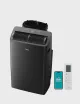
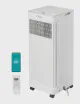
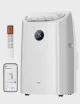
The Midea Duo 14K (B0GV45RBM2) at $659.99, 4.3★ from 24 early reviews, is the PortaSplit’s closest US-market sibling — same brand, same engineering DNA, but architected as a dual-hose portable rather than a split system.
The dual hoses eliminate the negative-pressure problem that plagues single-hose monoblocks: one hose pulls outdoor air across the condenser, the other exhausts the hot air. The result is ~30% better cooling efficiency than a standard portable at the same BTU class. Reviewer TubaSunGod confirms: “the dual hose has eliminated the issue with hot air being sucked back into your home.”
| Spec | Detail |
|---|---|
| BTU (ASHRAE / SACC) | 14,000 / 12,000 |
| Price | $659.99 |
| Rating | 4.3 / 5 (24 reviews) |
| Noise | ~48 dB (inverter compressor) |
| Window fit | Standard sliding/double-hung (dual hoses) |
| Smart | Alexa, Google, remote |
| Lease impact | Zero — window kit only |
The tradeoff: it is a 2026 model with only 24 reviews, so long-term reliability is unconfirmed. The window kit materials received a complaint from reviewer Michael Maierhofer (“cheapest materials and design I have ever encountered”), and replacement kits run $25-$40. For a renter who wants the PortaSplit experience but lives in the 115V world, this is the closest match.
Also Consider — DREO 515S 12K Smart
The DREO 515S (B0F3HRSN8B) at $479.99, 4.4★/429 reviews, is the quietest monoblock in this roundup and the highest-rated of the US options.
The 12,000 BTU ASHRAE (8,000 DOE) cools mid-size bedrooms up to 350 sq ft with drainage-free operation — no water bucket to empty, no condensate pump. The magnetic remote dock, smart app integration, and voice control make it the most polished monoblock on the market. Reviewer Eric de Rouge researched over 200 portable ACs and concluded: “I’m so so glad I did not buy the cheaper brands.”
Also Consider — BLACK+DECKER 8000 BTU Portable
The BLACK+DECKER 8000 (B01DLPUWL2) at $299.99, 4.1★/16,017 reviews, is the most-proven portable AC on Amazon.
16,017 reviewers cannot all be wrong — this unit cools small rooms effectively at a price that does not hurt. It covers 100-200 sq ft according to most buyer reports (Midea’s 400 sq ft claim is generous).
The drawbacks are real: some units develop a loud buzzing noise (reviewer L: “almost unbearable”), and the 3,950 BTU SACC is noticeably weaker than the Midea alternatives. For a year or two of light summer use in a small rental bedroom, it works. Plan to replace it in 2-3 years.
Also Consider — Midea 8500 Smart Portable
The Midea 8500 Smart (B0DQW6R81R) at $239.99, 4.0★/394 reviews, is the budget pick.
Midea’s entry-level smart portable at 85% of the BLACK+DECKER’s price. The app control works well (buyer Candace H.: “Midea does it again”), and it is genuinely quiet for a monoblock in the $240 class. The downsides: 5,000 BTU SACC only covers 150 sq ft, no directional vents (the air blows in one fixed direction), and one 1★ review reports the unit stopped cooling entirely after 3 months. At this price, treat it as a seasonal purchase rather than a long-term investment.
Quick Comparison Table
| Spec | PortaSplit (Winner) | Midea Duo 14K | DREO 515S | B+D 8000 | Midea 8500 |
|---|---|---|---|---|---|
| Price | €1,199 | $659.99 | $479.99 | $299.99 | $239.99 |
| Type | Split-system | Dual-hose | Monoblock | Monoblock | Monoblock |
| BTU (ASHRAE) | 12,000 | 14,000 | 12,000 | 8,000 | 8,500 |
| BTU (SACC) | ~12,000* | 12,000 | 8,000 | 3,950 | 5,000 |
| Rating | 4.3★ | 4.3★ | 4.4★ | 4.1★ | 4.0★ |
| Reviews | 522 | 24 | 429 | 16,017 | 394 |
Performance & Features
| Spec | PortaSplit (Winner) | Midea Duo 14K | DREO 515S | B+D 8000 | Midea 8500 |
|---|---|---|---|---|---|
| Noise | 39 dB | ~48 dB | ~44 dB | ~52 dB | ~50 dB |
| Smart | App + remote | Alexa/Google | App + voice | Remote only | App + remote |
| Spec | PortaSplit (Winner) | Midea Duo 14K | DREO 515S | B+D 8000 | Midea 8500 |
|---|---|---|---|---|---|
| Heat pump | Yes | No | No | No | No |
| Drilling? | No (bracket) | No (hose kit) | No (hose kit) | No (hose kit) | No (hose kit) |
| Best for | EU renters | US upgrade | Mid-range quiet | Budget proven | Entry smart |
*PortaSplit uses split-system architecture — SACC rating not like monoblock.
FAQ
❓ Frequently Asked Questions
The questions that come up most when readers are shopping this list
What is renter friendly vs landlord friendly?
522 Amazon DE reviews at 4.3★. Renters confirm cooling 30°C to 22°C in one hour at 380W. Praised for quiet sleep.
How to make a house renter friendly?
Yes for 320-540 sq ft (30-50 m²). Verified buyers confirm 40 m² coverage. Midea's official spec says 42 m² / 105 m³ max.
Where can I download the Midea PortaSplit manual?
Three sources: Midea official page, Amazon DE listing documents, and Midea SmartHome app in-app manual.
Is the Midea PortaSplit sold in the USA?
No — 220-240V / 50Hz European-only. US alt: Midea Duo dual-hose portable at $659.99, 14K BTU.
The Bottom Line
For a renter staring at a 35-degree August evening with a lease that says no water-damaged walls and a landlord who already rejected your window unit request, the decision is really about architecture.
Every portable AC at $300-$500 is a monoblock — compressor inside, noise inside, negative pressure, hot air sucked back in through every gap in the apartment. The PortaSplit moves the compressor outside. That single architectural difference makes the €1,199 price feel like a bargain, not a splurge.
If you are in Europe with a tilt-and-turn window, buy the PortaSplit. You will feel the difference the first night you sleep without earplugs.
If you are in the US with $660 to spend on cooling, buy the Midea Duo. It is the closest thing to the PortaSplit experience in 115V land — and a meaningful upgrade from any single-hose unit you have owned before.
If you need something for a spare bedroom that gets used four times a year, buy the DREO at $479 or the BLACK+DECKER at $299. Both are the kind of purchase you do not overthink.
Personally, I keep the window bracket from the PortaSplit in my apartment between summers — the same approach that makes Command strips work for hanging art works for portable AC installation. Each summer it goes back on the sill in under five minutes, and each year I am surprised again that no wall holes were needed. That is the kind of solution I reach for, and the one I would replace tomorrow if it broke.