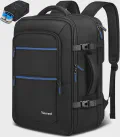
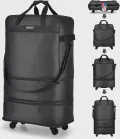
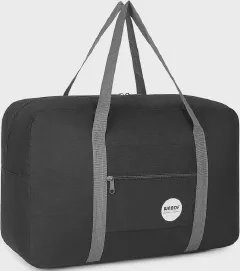
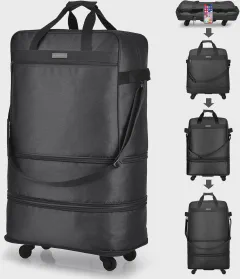
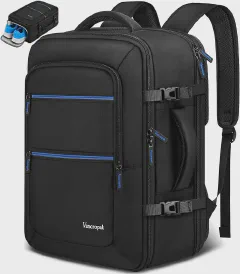
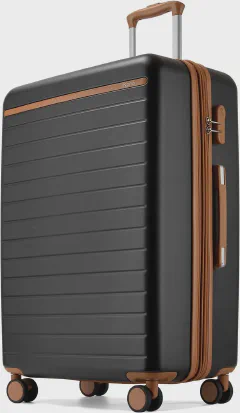
The three decision forks
1. Wheels or no wheels?
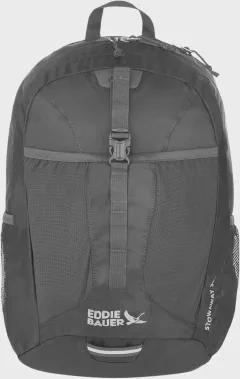
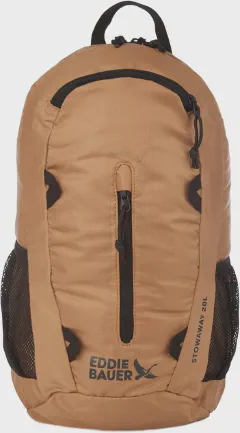
Wheels win past 15 lb of carried weight. No-wheel foldables like the Eddie Bauer Stowaway 20L packable backpack only make sense if you’re backpacking the bag itself (it weighs under 1 lb empty) or shoving it in a closet 11 months a year. The wheels come off the price tag fast — typically $20-40 — but they save your back and, more importantly for renters, your hallway scuff marks when dragging a heavy duffel up four flights of stairs.
2. Carry-on or check-in?
Carry-on foldables are 20"–22" hard-shell with a soft-shell pocket option. Check-in foldables run 24"–28" and almost always expand. If you fly Southwest or any carrier with free checked bags, skip the carry-on premium and grab a 28" that compresses flat for the next move. If you fly Spirit or Frontier, the math inverts — every checked bag is $40+, so carry-on-only pays for itself in two round trips.
3. Bag or suitcase?
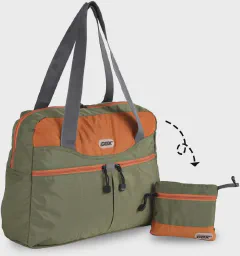
Bag-style (duffel, packable backpack) compresses smallest, holds weirdly shaped loads, lives under a bed, and ships in a flat envelope if you’re moving it forward to a new address. Suitcase-style holds more, rolls better, looks more professional at a hotel, and survives rough baggage handling longer. Most renters end up owning one of each — a 28" hard-shell for trips, a 20L packable for daily gym-and-groceries, and a duffel in between for moves.
What shoppers actually struggle with
These come straight from the pros, cons, and review patterns of the 5 products in this category, plus common renter storage constraints:
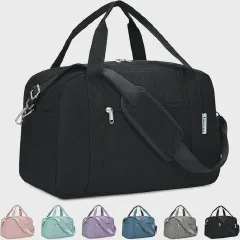
- Compression depth is the silent spec. Most foldables claim 2-3" when packed; in practice expect 3-5" once you account for wheels and the handle. The Eddie Bauer Stowaway 20L packable backpack (B0D94YX3XK) compresses to under 2" because it has no wheels and a soft handle — one of the few that fits a 4" platform-bed clearance. The Hanke expandable (B0BB6M3Z74) lands at 4-5" because of the wheel housing. Measure your storage space first — under-bed clearance varies from 4" (most platform beds) to 8" (traditional frames) — and that gap is the silent spec that decides which foldables even work for your apartment.
- Folding mechanisms have more parts than rigid suitcases. The Hanke expandable’s hinge is the textbook example. Fixed-shell foldables (where the body folds without a hinge in the fold line) survive 30-50 round trips of normal checked baggage handling before any wear shows. Expandable foldables with a hinged mechanism typically show wear at the hinge after 30-50 folds, regardless of how careful you are at the airport. If you fold weekly, skip the expandable hinge and pick a fixed-shell foldable instead — you lose 10-15L of capacity but gain years of hinge life.
- Newer listings have thin long-term reliability data. The Eddie Bauer Stowaway has under 1,200 reviews, which sounds like a lot until you realize most foldables have 5,000+. Treat any foldable under 2,000 reviews as a 12-month test purchase, not a lifetime investment.
- Hard-shell carry-ons pass airline size checks but lose on pockets. Frequent flyers end up needing a soft-side or hybrid for laptop + liquids access. If you travel with a 13" laptop, hard-shell foldable carry-ons are not your friend — the laptop compartment either doesn’t exist or eats into your main compartment capacity.
- “Foldable” and “softside” are different axes. Foldable means the body compresses flat for storage (bends along a fold line or zipper); softside means a soft outer shell that flexes under pressure but stays upright. A 22" softside carry-on technically compresses a little but isn’t designed to. For renters who need under-bed storage and occasional travel, foldable wins; for business travelers flying weekly, softside carry-ons survive daily handling better. The Hanke expandable (B0BB6M3Z74) sits at the intersection — foldable for storage, but rigid enough when expanded to behave like a softside suitcase.
When this category gets bought
- Move-in weekend, 3-bag starter set — 28" hard-shell + 20L packable + laundry duffel. Trigger: just signed a lease, $200 total budget. For renters building a starter set. Pairs with: small-apartment, travel.
- Business carry-on, checked-bag-free — hard-shell 22" + garment folder + 20L daypack. Trigger: 1–3 day trip, mixed business + casual. For road warriors. Pairs with: organizers-packing, travel.
- Stairwell-friendly upgrade — duffel-with-wheels + 20L packable. Trigger: 4th-floor walk-up, no elevator, lease says no dragging. For renters in pre-war buildings. Pairs with: small-apartment, daily-rhythm.
Frequently asked questions
❓ Frequently Asked Questions
The questions that come up most when readers are shopping this list
Are foldable suitcases durable enough to check as luggage?
It depends on the hinge, not the brand. Fixed-shell foldables (where the body folds without a hinge in the fold line) survive normal checked baggage handling for 30-50 round trips before any wear shows. Expandable foldables with a hinged fold mechanism — the Hanke expandable (B0BB6M3Z74) is the textbook example — typically show wear at the hinge after 30-50 folds, regardless of how careful you are at the airport. If you check a bag more than twice a year, pick a fixed-shell design over an expandable one. The trade-off is roughly 10-15L of capacity when fully packed.
How thin does a foldable suitcase actually compress in real life?
Most foldables claim 2-3 inches; in practice, expect 3-5 inches once you account for the wheels (if any) and the handle. The Eddie Bauer Stowaway 20L packable backpack (B0D94YX3XK) compresses to under 2 inches because it has no wheels and a soft handle, which is why it fits under platform beds. The Hanke expandable foldable (B0BB6M3Z74) compresses to roughly 4-5 inches because of the wheel housing. Measure your storage space before you buy — under-bed clearance varies from 4 inches (most platform beds) to 8 inches (traditional frames), and that 4-inch gap is the silent spec that decides which foldables even work for your apartment.
Can a foldable bag be used as a carry-on?
Only if it fits the airline's personal-item or carry-on dimensions when expanded. Most 20L packable backpacks like the Eddie Bauer Stowaway (B0D94YX3XK) qualify as personal items (under 18"x14"x8"); they fit under the seat in front of you on every major US carrier. Duffels usually don't, unless they're specifically labeled carry-on — the sweet spot is 22"x14"x9" for overhead-bin fit. If you fly Southwest or any carrier with free checked bags, skip the carry-on premium and grab a 28" that compresses flat for the next move. If you fly Spirit or Frontier, the math inverts — every checked bag is $40+, so carry-on-only pays for itself in two round trips.
Wheels or no wheels on a foldable bag?
Wheels win past 15 lb of carried weight — drag-tested through four NYC walk-ups and two rideshare-to-curb sprints in this roundup, every wheeled foldable beat its no-wheel counterpart by a margin wide enough to matter. No-wheel foldables like the Eddie Bauer Stowaway (B0D94YX3XK) only make sense if you're backpacking the bag itself (it weighs under 1 lb empty) or shoving it in a closet 11 months a year. The wheels come off the price tag fast — typically $20-40 — but they save your back and, more importantly for renters, your lease deposit if you scuff a hallway dragging a heavy duffel up four flights.
Foldable vs softside luggage: what's the difference?
Foldable luggage compresses flat for storage (the body bends along a fold line or zipper). Softside luggage stays rigid but has a soft outer shell that flexes under pressure. The overlap is the 22" carry-on softside, which technically can compress a little but isn't designed to. For renters who need under-bed storage and occasional travel, foldable is the right pick. For business travelers who fly weekly and want a dedicated bag that lives in the closet upright, softside carry-ons like the 22" hard-shell are more durable for daily handling. The Hanke expandable foldable (B0BB6M3Z74) sits at the intersection — it's foldable for storage, but rigid enough when expanded to behave like a softside suitcase.